
Chris Marquis’s New York Times op-ed, “I Teach at a Business School. It’s Time to Shut Them Down”, has attracted substantial attention. It has been widely praised for blowing the whistle on a sector which allegedly indoctrinates smart young people into extracting as much profit as possible from society.
I approached the article with considerable sympathy. Sustainable business is my core research focus, and I care deeply about teaching and wider impact. I’m also open to criticism of both business schools and capitalism. My essay, “The Purpose of a Finance Professor”, explored how professors of finance – and business more broadly – can become more purposeful. My research has covered topics such as the long-term costs of short-term CEO incentives, conflicts of interest in investment banking, and how higher carbon emissions are associated with greater stock returns. I also have great respect for Chris. I gave a five-star Amazon review of his book The Profiteers (under “AlexE”), and we served together on the judging committee for the Life’s Good Award, LG Electronics’ innovation challenge to benefit society, where he provided excellent insights.
Chris should be applauded for his courage in writing this article. Critiquing your own profession can lead to significant personal and professional costs. Business schools should be willing to ask difficult, even uncomfortable questions, about what we do and look for ways to improve. Unfortunately, I found the critique unconvincing. In particular, the same oversimplification that Chris criticises in business schools runs throughout his article, which presents a straw-man caricature of both business and business schools. The article is muddled, confused, and internally inconsistent, with logical leaps from otherwise valid critiques in an attempt to turn every observation into a claim that business schools harm society.
- Misportrayal of Business
Running throughout the whole article is the “pie-splitting” mentality that business is a zero-sum game – that profits are necessarily at the expense of society. Chris claims that business school’s “central question” is “How do we maximize shareholder value?”, which he equates as short-term profit extraction.
This is a fundamental misrepresentation of what shareholder value is. Finance 101 stresses how shareholder value is an inherently long-term concept: it is the present value of a company’s future cash flows, including those arising decades into the future. Indeed, some of the most valuable companies today are tech firms whose market value is orders of magnitude greater than their quarterly earnings. My textbook, Principles of Corporate Finance, which is widely taught across business schools, introduces on page 1 of Chapter 1 “five themes that occur again and again throughout this book”, the second of which is “Maximizing shareholder value involves considering the long-term consequences of all decisions, including their effects on stakeholders such as customers, employees, and the environment.”
Great companies do not just create shareholder value; they grow the pie for society. They make products that improve customers’ lives, create good jobs and enriching workplaces, and forge strong supplier partnerships. For example, companies listed in the 100 Best Companies to Work For in America delivered shareholder returns that beat their peers by 2.3% to 3.8% per year over a 28-year period. This study was independently replicated a decade later and found to be robust even with more recent data.
Shareholder returns also play a key role in society. They reward investors for risking their capital, which only earns a return – if at all – after all other stakeholders have been paid what they are owed. And investors are not “them” – nameless, faceless capitalists – they are “us”. They include parents saving for their children’s education, pension schemes investing for their retirees and insurance companies funding future claims. Profits not distributed to investors can be reinvested by the company, either internally in R&D or externally through initiatives such as the Life’s Good Award.
More broadly, research on sustainability has proliferated. Leading academic journals have devoted entire special issues to sustainability, climate, and biodiversity, and whole conferences are organised on these topics. Chris is correct that “many foundational studies supporting the win-win idea [that sustainability improves profits] were based on flawed data or couldn’t be replicated”. But that contradicts the entire thrust of his article. If business schools are indeed exaggerating the business case for sustainability based on flimsy research, then they are encouraging students to do too much of it, not too little.
A similar contradiction arises in Chris’s concern that “some of the most celebrated ideas in management have not been the ones that survive peer review replication, but the ones that could be turned into TED talks, consulting frameworks, or airport bestsellers.” I fully agree with this critique, and my second book May Contain Lies was on how flimsy research can go viral if it feeds on confirmation bias. But again the conclusion is a non-sequitur. These “celebrated ideas” are rarely about maximizing profit at the expense of society; I know of few airport bestsellers which give these messages. Indeed, books such as Start With Why, Good to Great, and Built to Last exploit confirmation bias by giving messages that people want to hear – that values-led leadership pays off.
There are indeed limits to win-win thinking, and sustainability involves diminishing returns and trade-offs. In particular, companies can emit externalities on wider society, such as carbon emissions, that do not reduce profits even in the long term. But the solution is to address the root cause – the underlying externalities – through taxation and regulation – not to abolish business schools. What if government intervention is insufficient? Core finance theory, taught in finance textbooks, highlights how shareholders may care about externalities in their own right. A pension fund’s beneficiaries may value the state of the planet when they retire, not just their pension income. In that case, a CEO best serves shareholders by sacrificing profits to address the externalities.
- Misportrayal of Business Schools
Chris implies that because he teaches at a business school, he is an expert on what is taught in business schools and therefore can make the strong claim that “it’s time to shut them down”. However, it is unclear how much Chris knows about his own business school, let alone business schools in general.
When I asked Chris whether he knew any of the Cambridge finance faculty, he said he had very limited interaction with them as he’s not in that department. This is entirely understandable and commonplace: most professors are highly siloed, focusing on a narrow sub-discipline – this is how they become world experts. But it does mean that it is very rare for a professor to sit in a colleague’s lecture or even read their syllabus, particularly outside their department. This may explain his misunderstanding of what finance textbooks teach. It also may explain why he treats the case study method as representative of business school teaching. Case studies may be ubiquitous at Harvard, but many other professors teach primarily from textbooks, which synthesise broad principles and research across hundreds of companies rather than isolated anecdotes. Professors may intersperse case studies but to illustrate a principle, rather than deriving the principle from the case.
Chris makes valid critiques about case studies: that they are “carefully packaged corporate narratives … The data they include can be selective, biased or even fabricated.” As I write in May Contain Lies, they are sometimes single examples, hand-picked to demonstrate a point in the most vivid way, and may not generalise: “a fact is not data, because it may not be representative”. But to equate the teaching of cherry-picked examples to the teaching of profit extraction is a huge non-sequitur. Again, the problem could go the other way. For example, the Harvard case studies of Nexans, Clover Food Lab, and Too Good to Go imply that sustainability has clear financial benefits, ignoring the many counterexamples.
Chris does not provide any evidence for the claim that, when teaching cases, “complexity is systematically shaved away, and dissenting voices often go unheard.” Indeed, the best professors teach nuance and complexity. 20 years ago, a great teacher needed to go above and beyond the textbook. 10 years ago, you needed to also outperform Wikipedia and other web sources. Today, you need to outshine AI. This involves highlighting interdisciplinary interactions, trade-offs, and counterexamples. Now it is indeed likely that some professors regurgitate the suggested solution in the case teaching notes, just as some may teach shareholder value incorrectly. But the remedy is to improve teaching standards, not abolish business schools: indeed, Chris teaches the very case (“Rob Parson at Morgan Stanley”) that is Exhibit A of his criticism. That suggests the problem is not the case method itself, but how cases are taught. The article could have been much more constructive – and still provocative and click-worthy – were it about “Why Are Business School Cases So Badly Taught?” and suggesting how teaching could be improved.
He also claims that asking students to take the CEO’s perspective in a case necessarily excludes everyone else. But the CEO’s perspective is exactly the one to take, as she is ultimately responsible for workers, customers, suppliers, communities, and the environment, and many of these consequences feed through to shareholder value. A CEO has to deal with difficult trade-offs that an individual stakeholder does not: for example, shutting down a polluting plant helps the environment but costs workers their jobs. The answer to Chris’s question “Who made this person the legitimate protagonist?” is simple: the buck stops with the leaders. This is why the CEOs of Rio Tinto, Wells Fargo, and Volkswagen resigned following scandals on their watch, even though they were not the frontline employees who carried out the misconduct.
In addition to ignoring the fact that the classroom is far more than case studies, the article also ignores the fact that an MBA education extends far beyond the classroom. Again, this is not Chris’s fault, as professors are generally not expected to engage in co-curricular programs. My perspective is unusual because I invested heavily in teaching, particularly in the early part of my career – interacting with students on a personal level, learning about life beyond the classroom, and participating in co-curricular activities – efforts that contributed to 31 teaching awards. Through those relationships, I have seen how much students learn from one another in study groups: they work with people from different backgrounds, navigate disagreement, and help teammates master subjects in which they have more experience. Students also push themselves beyond their comfort zones through leadership ventures, such as military bootcamps at Quantico or summitting Cotopaxi volcano, developing public speaking and negotiation skills, and learning new languages. They also contribute to the wider community by organising treks to their home country over the holidays, forgoing the chance to travel somewhere new, and taking part in social-impact and community projects. My proudest moment at Wharton, where I started my career, was leading the Wharton Against Cancer team to run the Philadelphia Half and Full Marathon, which raised more money for the American Cancer Society than any other team, with some first-time runners crossing the finishing line. These wider experiences develop skills and relationships that classroom cases alone cannot provide.
- The Counterfactual
One of the core tenets of business research is to consider the counterfactual. To show that a management practice has a causal effect, you need to consider what would have happened without the intervention. Here, we do not see the hypothetical world without business schools, but we can obtain suggestive guidance by observing what alternatives already exist.
Loosely speaking, business schools provide two roles. The first is Education: improving a student’s human capital. The alternative is for employers to do so themselves – as has been happening for decades. Chris highlights investment banking as a career that business schools allegedly push students into. In Europe, there are two paths to Associate, the second rung up the ladder: an MBA, or joining as an Analyst (the entry-level position) and then being promoted based on your on-the job training. At Morgan Stanley, my former firm, this was known as the ACP (Accelerated Career Path). If business schools disappeared, investment banks would likely conduct all their own training (or outsource it to specialist agencies) which would be narrowly focused on finance, rather than other disciplines such as marketing, strategy, and organisational behaviour. As Nobel Laureate Gary Becker showed, employers will only provide firm-specific training; general training needs to be funded by the state or by the student themselves by going to business school.
My undergraduate degree was joint between an economics department and a business school. The required business curriculum spanned numerous disciplines: not just finance, but organisational behaviour, human resource management, strategy, marketing, accounting, and information management. This background shaped my interdisciplinary research, such as the intersection of finance with human capital topics such as employee satisfaction and diversity, equity, and inclusion.
The second role is Certification. Another Nobel laureate, Michael Spence, showed that a degree signals a student’s quality: the university undertakes rigorous assessments in its admission decisions. This gives employers the confidence to hire candidates from non-traditional background into business careers, such as former athletes, teachers, and Peace Corps volunteers, military veterans, or non-profit workers, because they bear the MBA stamp. Indeed, business schools are often used to switch careers. Without them, employers might draw on a much narrower set of candidates, such as those who studied business as an undergraduate and have worked in the field ever since.
- Unsupported Inferences
There are additional examples of unjustified conclusions, again suggesting a desire to turn every point into an argument against business:
- Chris contrasts business with “nobler goals” such as “engineers who want to commercialize clean energy, physicians determined to fix the health care system, nonprofit leaders who have watched good missions fail for want of good management”. But it is not engineers who are needed to commercialize clean energy; venture capitalists are needed to fund it, and a C-suite to run it. Physicians can fix the healthcare system, but CEOs can fix healthcare companies. Companies, not just nonprofits, watch good missions fail for want of good management.
- His criticism that business schools promote “deal-making, simplification, and optimization” is also unwarranted.
- A deal is freely entered into by two parties, so they only do so if both are better off; indeed, this is a common argument against trade barriers. An engineer commercialising clean energy is a deal. Now some deals may have negative externalities on third parties, if regulation is ineffective, but this is not an argument to view all deal-making as nefarious.
- Chris presents no evidence that business schools promote simplification. This claim takes a rather dim view of students, as if they will only accept dumbed-down arguments and do not recognise that navigating complexity is essential preparation for an increasingly competitive job market.
- The criticism of optimisation is particularly bizarre. Fixing the healthcare system and not watching good missions fail are examples of optimisation.
- The contrast between business schools and medical and law schools, which Chris claims produce “undisputed public goods”, is also unsupported. Lawyers would hardly top most people’s lists of the most virtuous professions, which makes the claim hard to take seriously. Lawyers can protect vested interests, obstruct accountability, and extract settlements from innocent defendants; there are many serious cases of medical malpractice. Almost all professions can create social harm as well as social good; the challenge is to reduce the former and increase the latter, not throw the baby out of the bathwater.
Overall, this article bears a striking resemblance to Tariq Fancy’s “A Secret Diary of a Sustainable Investor,” which was similarly an insider blowing the whistle on his industry. Fancy went viral for it even though the criticism was disproportionate and unevidenced, based on one person’s narrow experiences, and I critiqued it here. However, it did spark valuable reflection within the industry. Similarly, despite the issues in Chris’s article, I hope it does promote discussion on how business schools can do better, as there is substantial room for improvement. Chris correctly highlights the flaws in the case study method and the presentation of flimsy research; in “The Purpose of a Finance Professor” I highlighted the zero or negative weight placed on teaching and impact in tenure and promotion decisions, and the problems with evaluating research based on counting publications with little attention placed to novelty, quality, or relevance. The answer is to correctly identify the shortcomings of business schools and address them, not to abolish them or jump to a solution based on an inaccurate diagnosis.
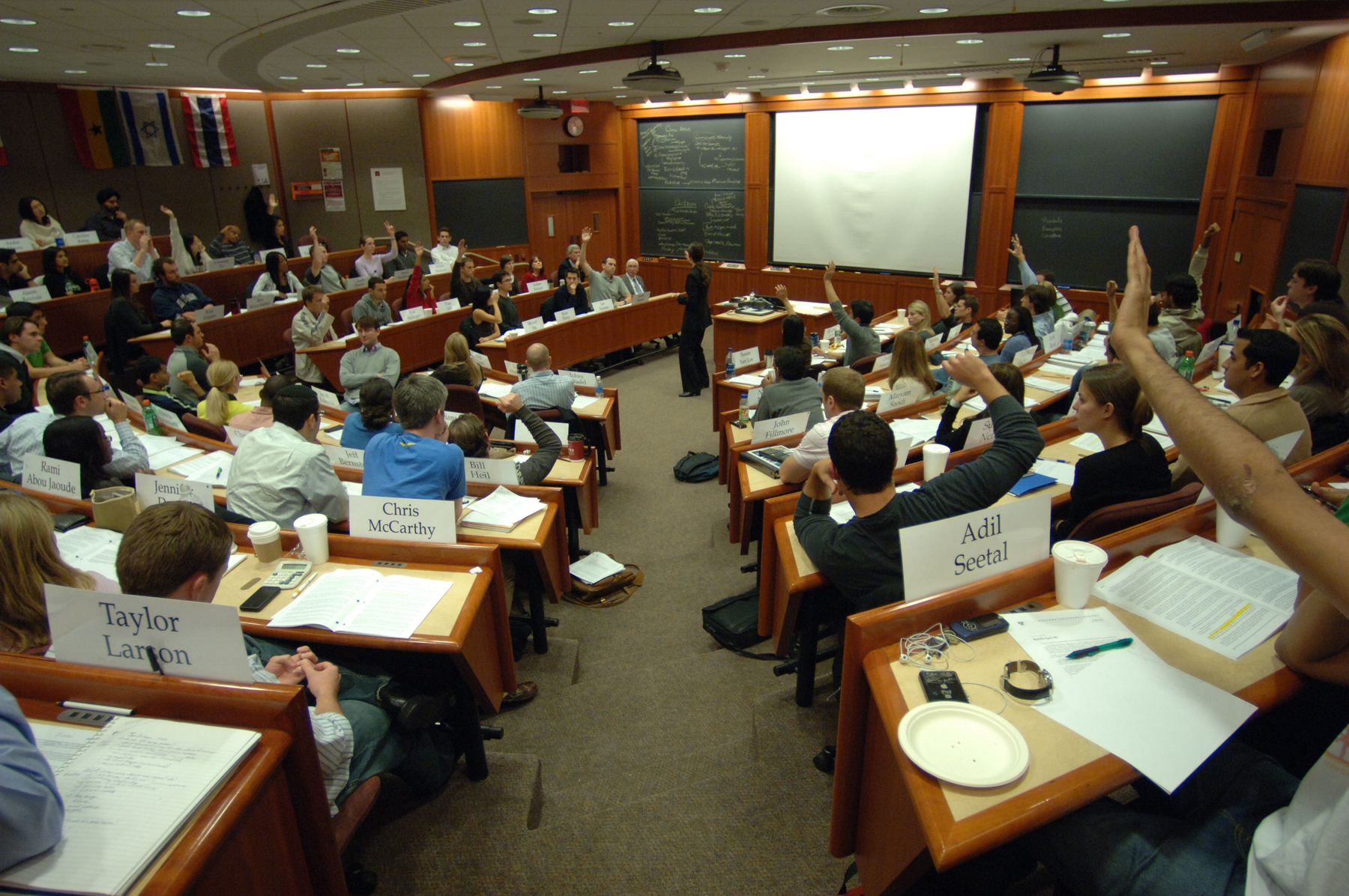
Photo: HBS1908, “Students in a Harvard Business School classroom,” CC BY-SA 3.0, via Wikimedia Commons.